Urban water systems are no longer viewed solely as public utilities. Today, they are fundamental to climate resilience, public health, social equity and sustainable urban development.
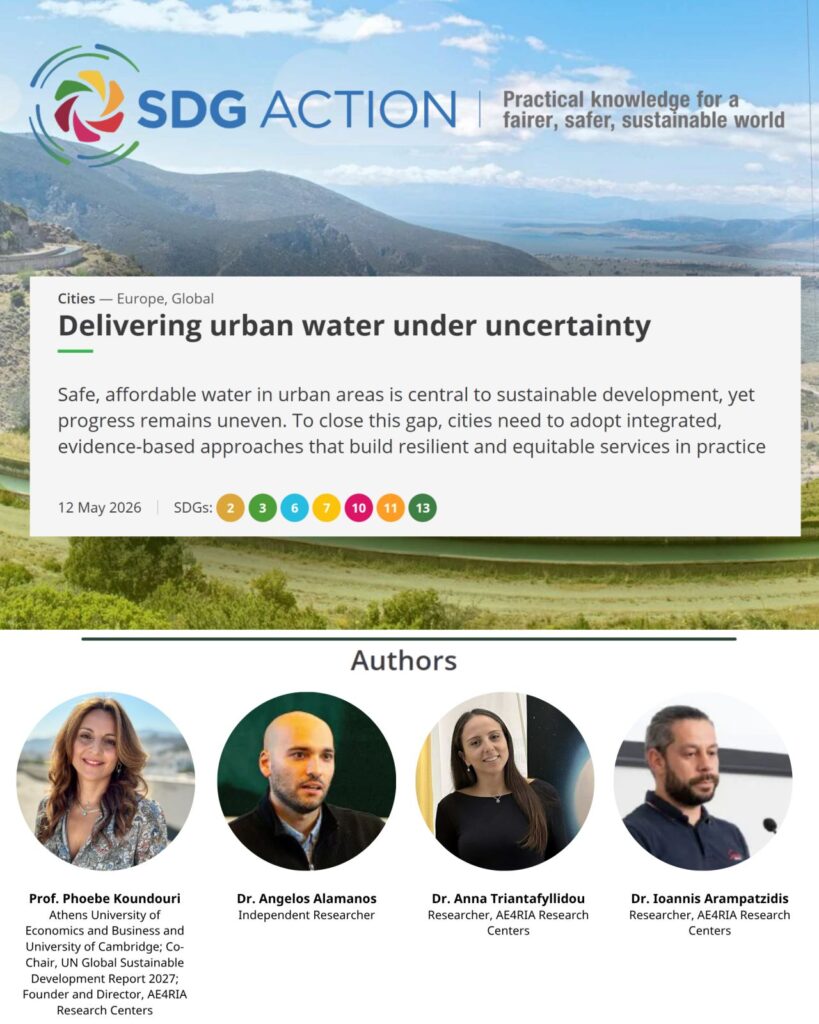
In a new article published in SDG Action, co-authored by Phoebe Koundouri, Angelos Alamanos, Anni Triantafyllidou and Ioannis Arampatzidis, the authors examine how cities can ensure safe, affordable and reliable water services in an era of increasing uncertainty.
The article builds on the European Research Council (ERC) funded Water-Futures project, which develops integrated approaches for “learning” urban drinking-water systems through cross-sectoral modelling, digital twins, real-time monitoring, socio-economic analysis and Living Labs.
The authors highlight the growing pressures facing urban water systems, including climate volatility, ageing infrastructure, pollution risks, seasonal demand peaks and affordability challenges. Addressing these interconnected risks requires more than technical solutions alone. It also demands socio-economic, political and behavioural approaches that can support long-term resilience and equitable access.
The Water-Futures project promotes evidence-based decision-making by connecting water availability, infrastructure, demand, energy, finance, affordability and social equity within integrated analytical frameworks. Through transparent testing and stakeholder engagement, the project aims to help cities evaluate and scale effective solutions for sustainable water management.